Research
By understanding the chemical, nebular and stellar properties of galaxies in the local and early we are able to answer many key questions about the evolution of galaxies and the Universe.
- How did the first galaxies form stars and produce their first heavy elements?
- How do the relative abundances of different elements reveal the stellar populations responsible for enriching galaxies?
- How do chemical abundances constrain the processes regulating the evolution of galaxies across cosmic time?
The cards below detail some of my publications, collaborations I have worked in, and other fun research highlights.
⍺-enhancement in high-z galaxies
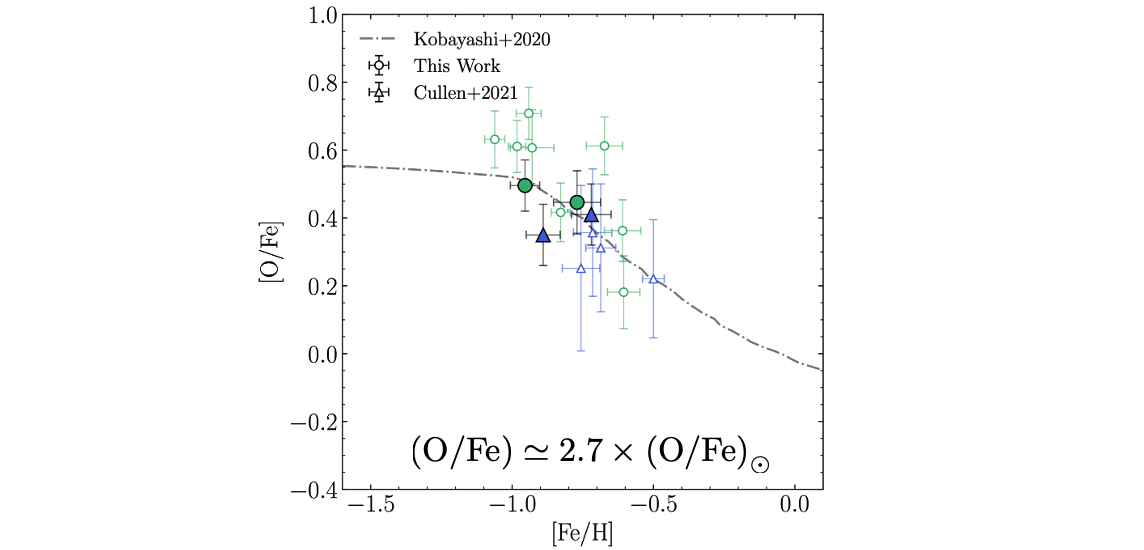
Galaxies in the early Universe do not show the same chemical composition as galaxies today. A key result of Stanton et al. (2024) demonstrated that galaxies at cosmic noon were deficient in Fe with respect to O. I measured Fe/H abundances from stellar FUV continuum fitting, and O/H abundances from nebular emission lines. Stars with an Fe deficiency at fixed metallicity produce harder ionizing spectra, explaining why the early Universe is a more highly-ionized place.
Chemical Evolution Modelling
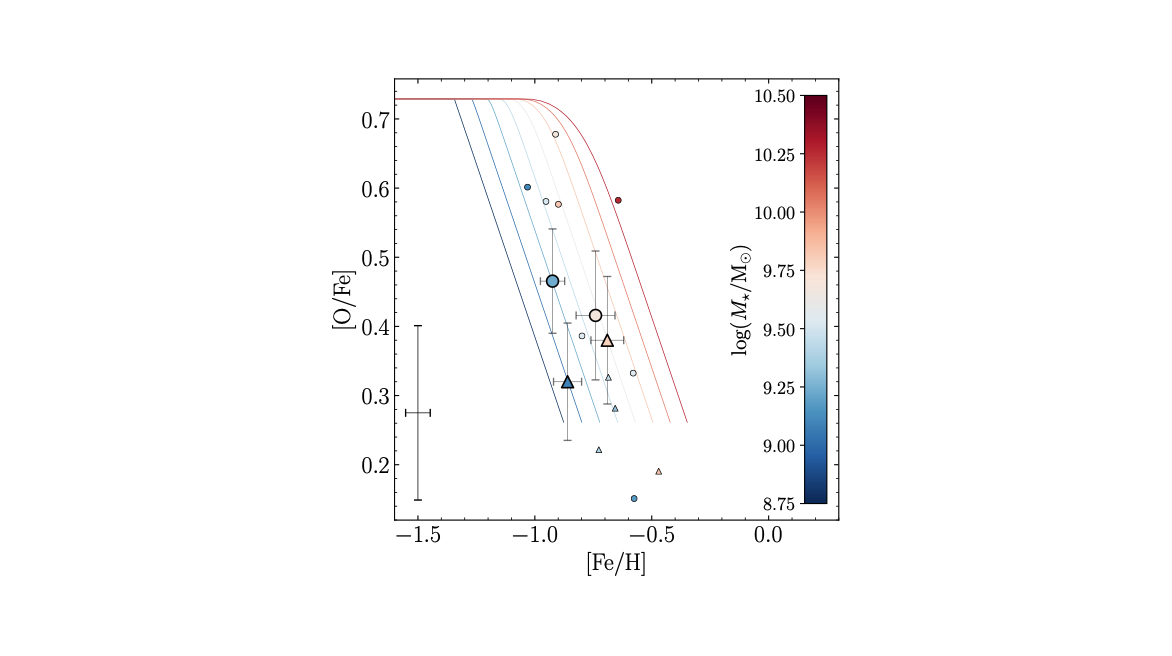
Applying chemical evolution modelling to the abundance patterns yielded a model in which the star-formation efficiency is lower in lower-mass galaxies due to enhanced outflows, consistent with expected relationships from simulations. Outflows are often invoked to explain the shape of the mass-metallicity relationship. My results demonstrated that this interpretation was consistent with observed abundance patterns in high-z galaxies for the first time.
Argon Abundances
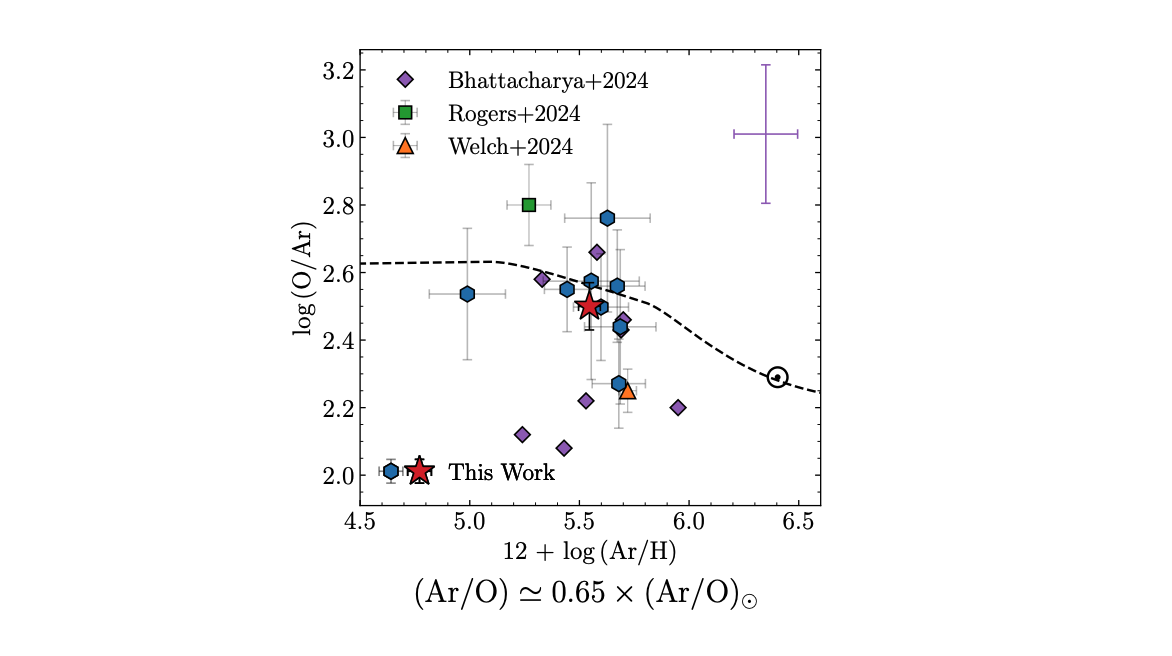
I published the first sample of gas-phase argon abundances at high-redshift, with eight galaxies from JWST EXCELS. The Ar/O ratio was found to be generally sub-solar, indicating that galaxies were Ar-deficient, mirroring trends seen with Fe abundances. This study laid the foundation for a number of other studies investigating Ar at high-redshift with larger samples of galaxies.
Bridging to the Milky Way
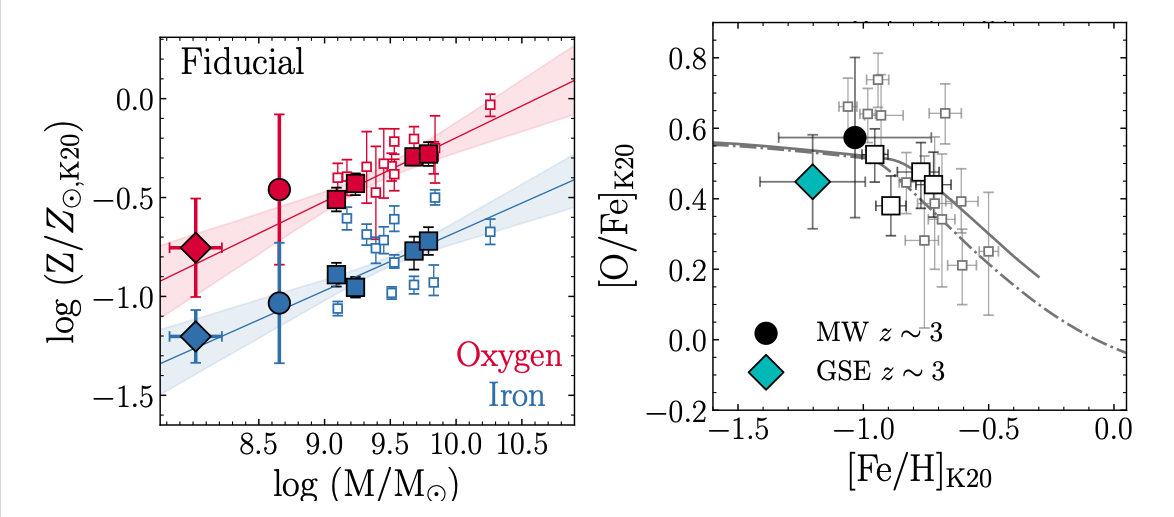
As part of the ChemZz group, in a paper lead by Dr. Stephanie Monty, I helped combine existing O/Fe studies at high-redshift and connect these with abundance patterns measured in the Milky Way. We found consistencies between the abundance patterns, suggesting that we may be able to build connections with the evolution of high-redshift galaxies by looking at the most resolved galaxy we have: our own Milky Way.
Metallicity Scaling Relationships
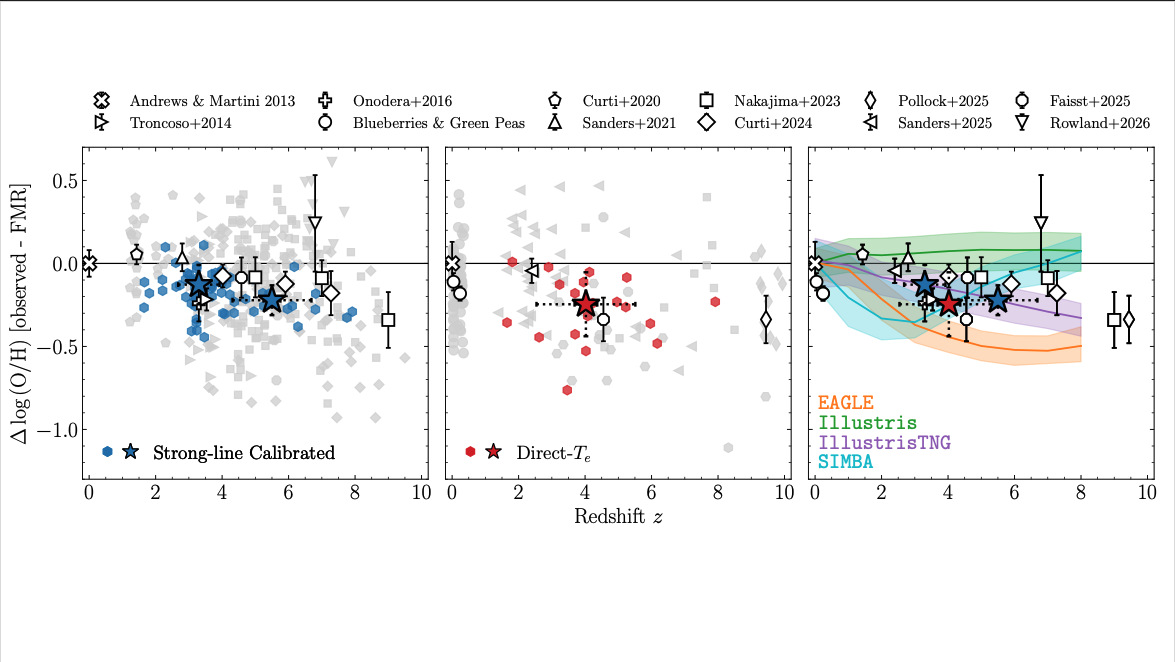
Chemical and Galaxy Evolution are often studied using scaling relationships, such as the mass-metallicity and fundamental metallicity relationships. I presented these relationships for the EXCELS sample, finding evidence of a rapid enrichment of metals at high-redshift. Galaxies at z > 3 were found to be offset from the local FMR, potentially that the processes regulating galaxy evolution were not balanced at high-redshift, although this topic remains one of significant debate.
⍺-enhanced photoionization models
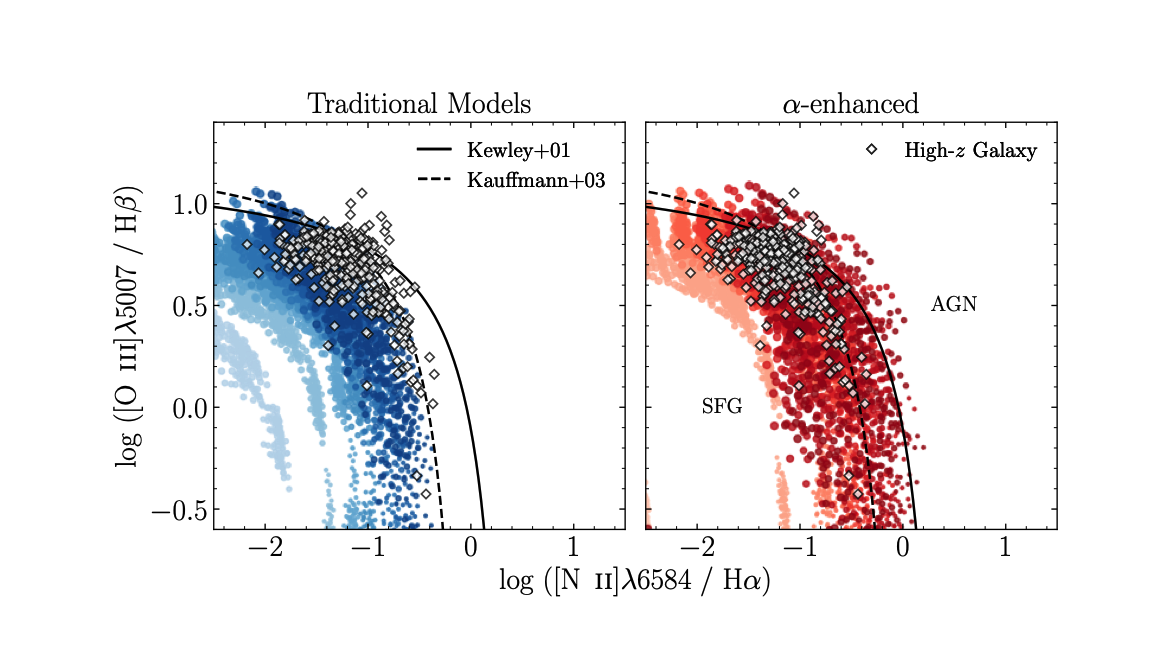
Using photoionzation modelling (CLOUDY) I have lead the development of the first set of ⍺-enhanced, non-solar abundance photoionization models. These models use chemical evolution tracks to match observed high-redshift abundance patterns. When applied to observational diagnostic diagrams, these models are able to reproduce the observed evolution in diagnostic ratios with redshift.
Paper Coming Soon
Surveys and Collaborations
EXCELS
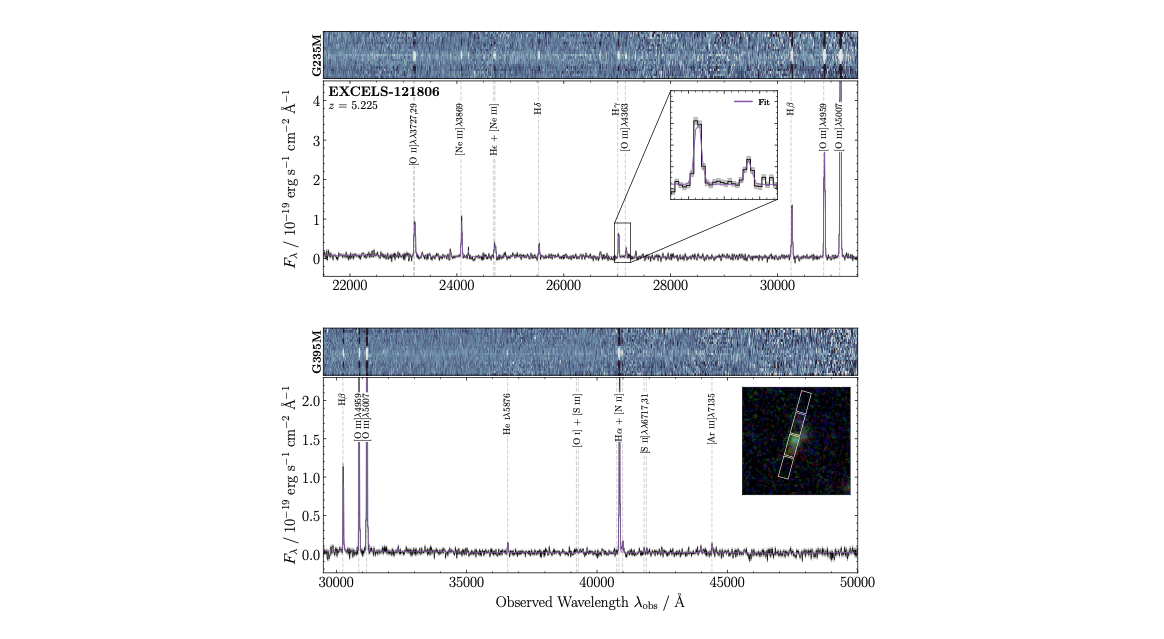
EXCELS is a Cycle 2 NIRSpec programme led by Adam Carnall and Fergus Cullen. EXCELS comprises ~350 star-forming and quiescent galaxies at 1 < z < 8 in the UDS field. As a key member of the EXCELS team, I was responsible for flux calibration, producing emission-line (in collaboration with Dr. Dirk Scholte) and galaxy property catalogues using the SED fitting code Bagpipes.
CAPERS
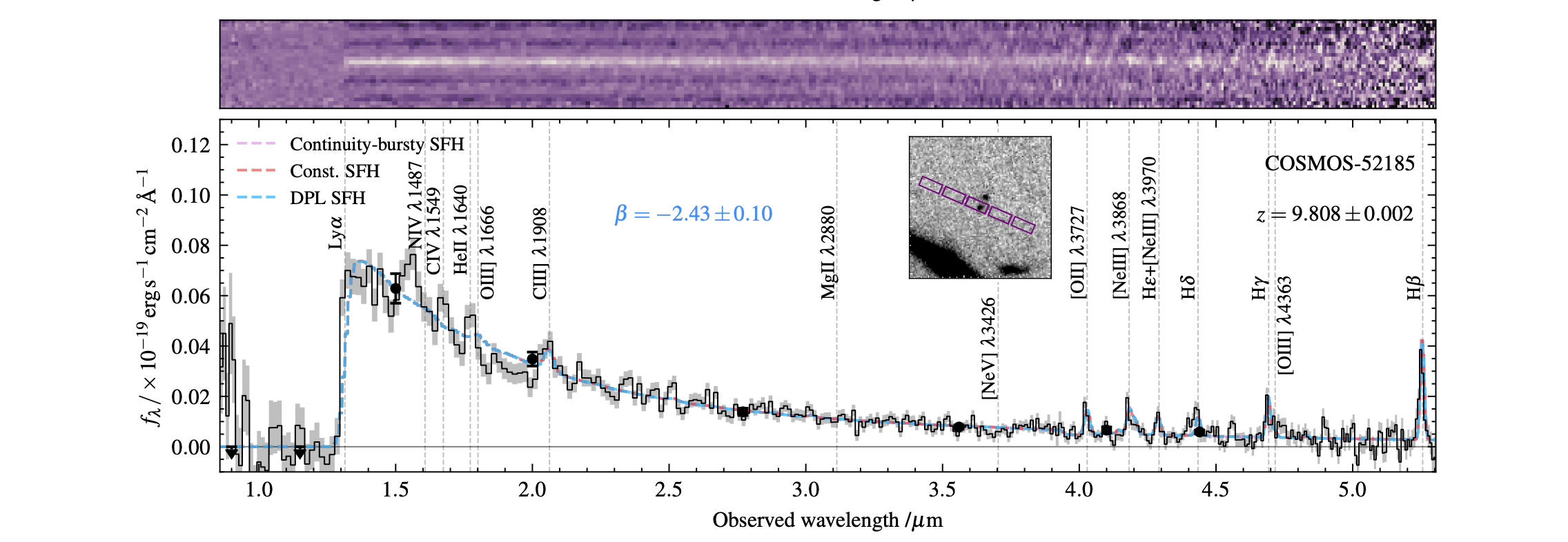
CAPERS is a collaboration, led by Mark Dickinson, which obtained PRISM spectroscopy for thousands of galaxies across multiple legacy fields. Within the CAPERS collaboration, I helped visually inspect, classify, and redshift thousands of galaxies, looking for interesting sources, AGN, and very high-redshift galaxies. I have contibuted to a number of CAPERS publications, including the measurement of metal content in galaxies at z~10.
ISSI Chemicals Workshop
In Summer 2026, I partipated in the ISSI Chemical Abundances workshop, which brought experts together to write review papers on the current status of chemical abundance studies at high redshift. This lead to the production of 4 review articles, of which I was heavily involved in 3.
Papers Coming Soon